Brian Garrison’s
Try Angle
A science fiction tree short story.
I lived in the Suiko Sea Colony, a dozen years after the World Trade Organization accepted our floating city states as a nation, the United Sea Colonies. Our colony had a hundred-thousand people, rafted together in thousands of rectangular ships, semi-drifting east of Japan.
I wrote in the Quarterdeck Teahouse, a hang out for neo-beatnik writers. It had few port-holes, so no distracting views and usually few other distractions, but not this time...
"You're a writer?" a man asked, standing at my table.
I didn't look up. "Trying to be," I grumbled, but his voice sounded odd, overly resonant. I couldn't resist peeking. A big man, tanned, and wrinkled enough to be a grandpa, glanced about like a fugitive.
I looked also at the Japanese teahouse, a normal half-empty afternoon. Most customers, other writers, sat alone, heads down in their virtual computers. Each table displayed a token cup of tea, not empty but long ago cold, like a torn ticket stub on display, proof admission had been paid, and wasn't due again.
I looked back to the big man, holding a mug, freshly steaming, with the smell of coffee. He had crewcut hair, a tall forehead, and clothes so bland as to be camouflage in a crowd. He looked at me with narrowed eyes.
I added, "Most of us are writers."
"Yes, but you're the only one writing on paper. I like that." He liked me being different or archaic?
I contemplated being rude (get lost), or polite (sit down). My head was full of plot, dialogue, and scenes. I needed to hold on to them, before they slipped away. He didn't know how his distraction pried thoughts out of my mind.
He didn't know the price I paid to be polite. I decided to respect my elder and waved him into the opposite chair.

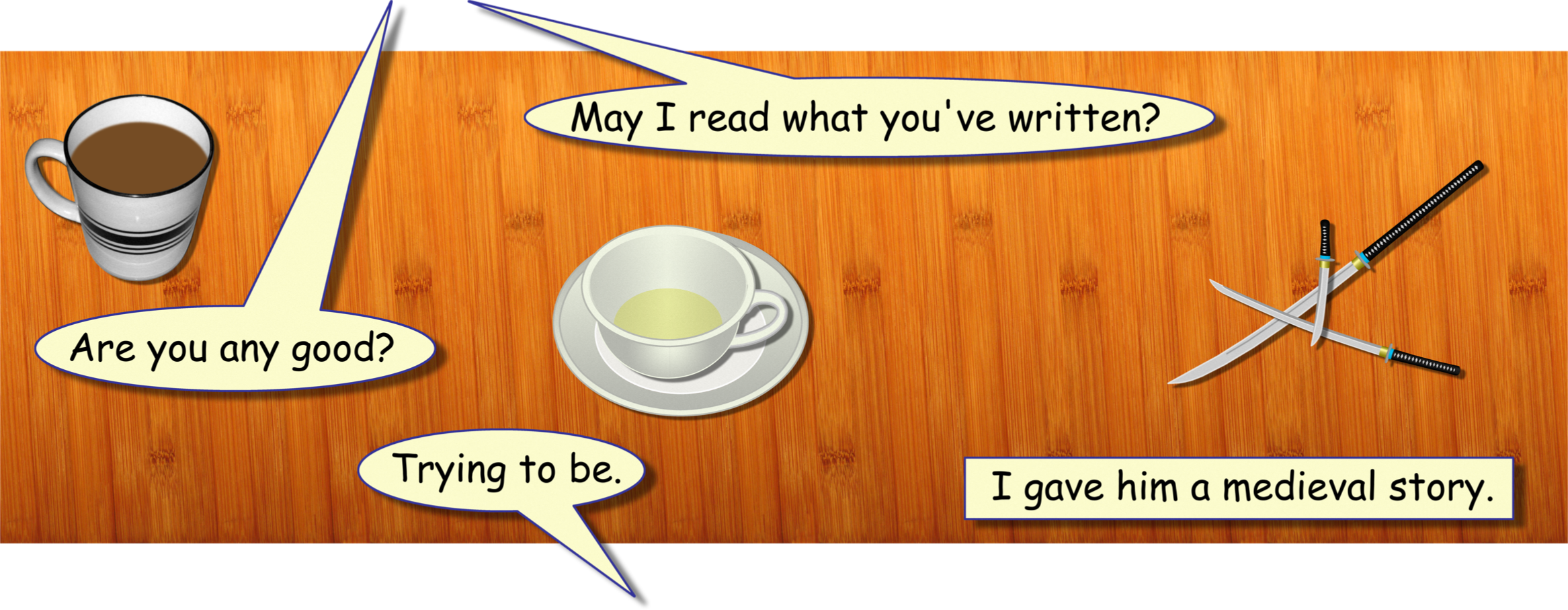
He took it, setting his coffee aside without tasting it, looked me in the eye, and asked, "Are you any good?"
Yeah, as if anyone has an impartial answer for that one. "Trying to be." I’m frustrated with my current story, but trying.
He nodded, worried eyes. "Sorry, I'm not saying it well..." Did he think my frustration was at him? "May I read what you've written?"
Kind of personal, I thought. Would you like to check my teeth, too? But he wouldn't under-stand. I took a breath. Might as well. I handed him my handful of pages written this session, for whatever good they would do him. It was chapter seven of an unknown number of chapters in a medieval fantasy. Too far into the story for the opening mystery, and not near the end to see where it would go.
He read, and I got back into my story, rereading my remaining, half-filled page. My rhythm was broken. Words not yet written, faded away like a dream when waking. Nuances I needed in mind were gone. I cussed to myself, but I anticipated further distractions. I noted ideas to remember, clues to let slip, and ones to hold back for later.
Distractions (like him) dissolve the world in my head, but sometimes interruptions (like him) can be useful, snippets of conversations and overheard stories from strangers. They let me see different views or inspire an odd detail.
Maybe this grandpa returned karma to me. Good or bad, though? I've learned to wait for such things to make sense.
I finished my notes and contemplated the old man. I sipped cold tea and wished I could write a manuscript, as fast as a person could consume one. When he set the last page down, he glanced about before looking at me.
Well? "Am I any good?" I tensed.
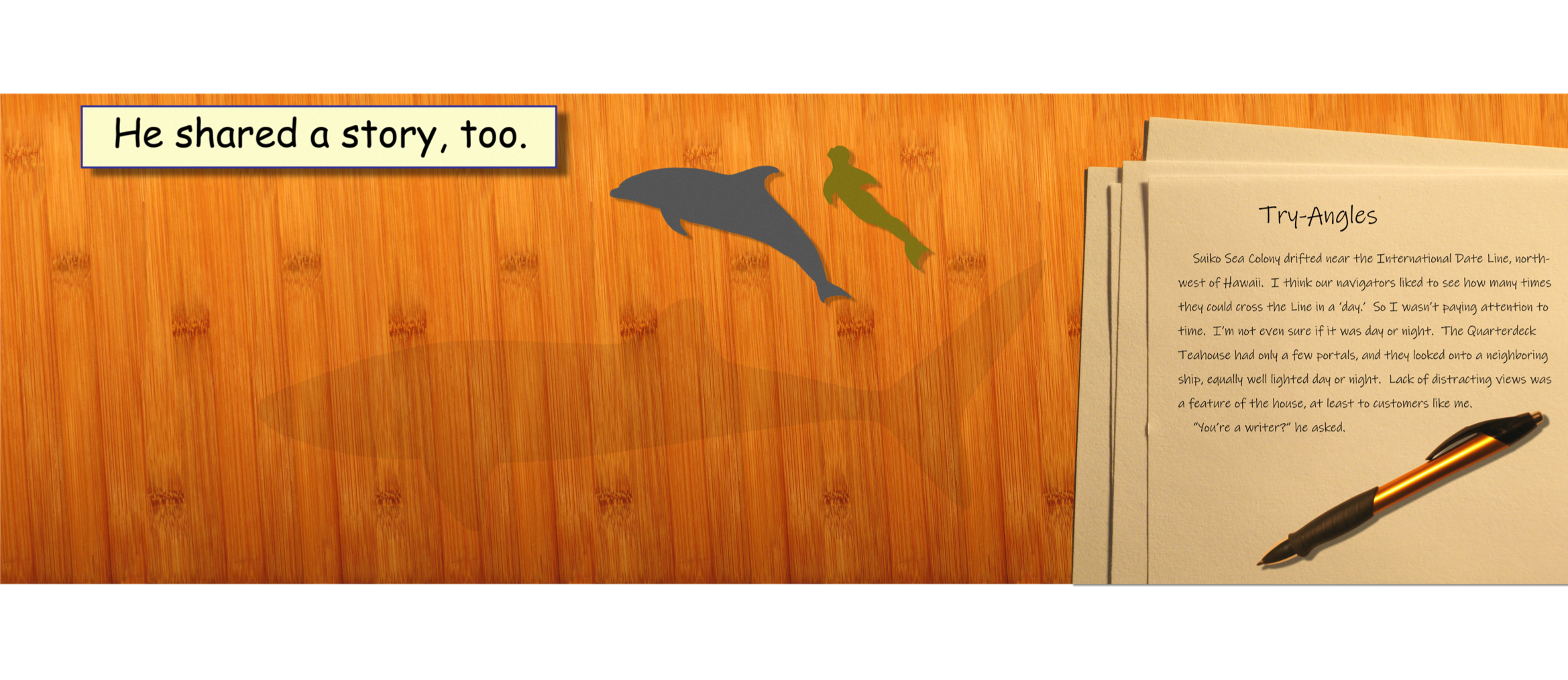
He nodded, "I liked it."
"It's a rough draft," I defended, maybe not believing him.
"Have you published anything?"
"Published? Yes. Sold... Not so much." It seemed time for him to explain, so I waited.
He said, "I have a story I want to tell, but I'm not writing it well."
I opted for non-committal, "Oh yeah?" There were plenty of how-to-write books, media, and support groups. The only reason to seek me out and wonder if I was any good, would be to ask me to write his story for him. I didn't know how I felt about it, having never faced the situation. I might as well listen. "About what?"
He glanced around and whispered, "I was born in Willow Bay."
Back estimating his apparent age... Willow Bay Sea Colony would have been a controversial military base, experimenting in genetic engineering of babies. Only one type of person was born there, and then.
"You're genetically engineered?" I shrugged, "You know, that's not such a big deal now?" Not like decades ago, when altered humans might be mobbed to death on sight, but growing up like that would be hard to forget.
He nodded, “I speak three dolphin languages and can swim indefinitely.”
He’s one of the original merpeople? Engineered to live in water, better than air, and to properly hear and speak dolphin? Does he still have his original tail gear?
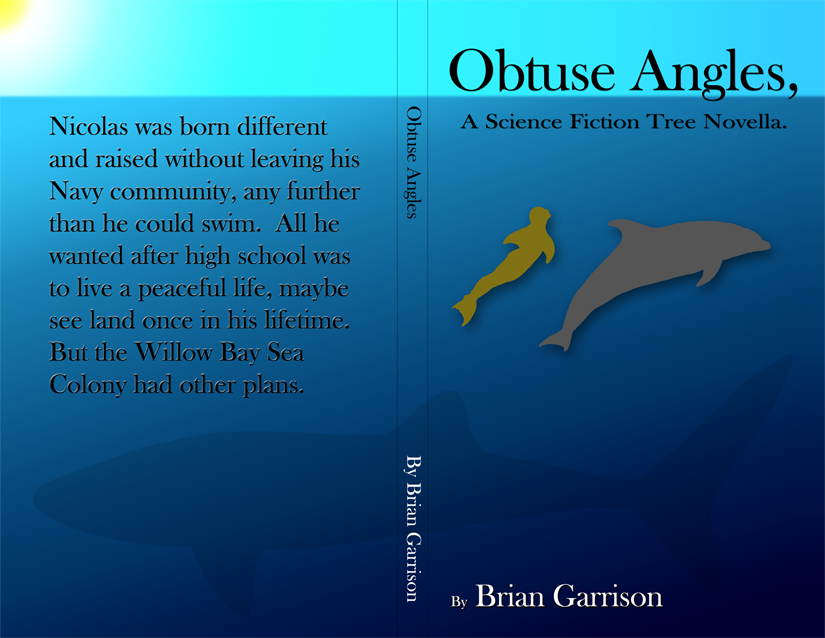
Good karma, for me. Maybe I should try science fiction. I leaned forward. "Please. tell me your story." His story became my first, successful novella:
Brian Garrison’s
Obtuse Angles
A science fiction tree novella.
Did you like the story?
Amazon lets you read the prequel’s first couple of chapters free.
Order the printed book or read in the Kindle app, on any device.
Maybe you would like one of my other stories?